

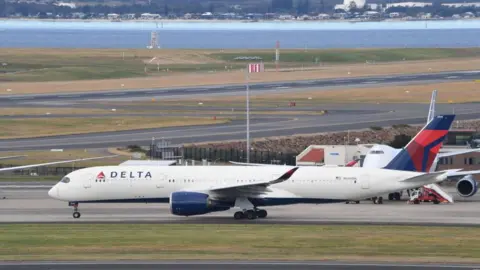
Multiple passengers and crew were hurt when a Delta Airlines aircraft from LA to Sydney, Australia experienced significant turbulence this past Friday.
The flight, numbered 41 "experienced a brief period of turbulence" as it landed at the Sydney airport, a company official stated. Four flight attendants were injured.
Local paramedics reported they treated five individuals, and took three to the hospital with non-life-threatening injuries that such as back pain and headaches. Those affected spanned from their 30s up to the 70s.
The event represents the latest incident of commercial jets being hit by severe turbulence, with researchers saying that global warming is a key driver.
There were 245 passengers and fifteen staff members on the wide-body jet, the representative noted, clarifying that the plane arrived "safely" at the airport at 06:48 local time on the day in question.
The NSW Ambulance Service reported they received a call just a mere three minutes before the plane landed, and ambulances were standing by on the runway.
Why plane turbulence is becoming increasingly prevalent - and more severe.
Last year, 25 people were injured when another Delta jet, travelling from Salt Lake City, Utah to Amsterdam, experienced "significant" turbulence just a couple of hours into the lengthy trip, and had to make an emergency landing.
Earlier this year, those on board on a Singapore Airlines jet endured a terrifying short but intense bout of severe turbulence. A traveler lost their life and dozens were injured, as those without seatbelts lifted out of their seats and were slammed back.
Turbulence is a common occurrence while flying, and while occurrences of significant turbulence appear to be increasing, they are still very rare.
Research indicates that there are an estimated five thousand cases of significant in-flight disturbance each year, out of a overall number of over 35 million flights that are conducted around the world.
Strong atmospheric disturbance is described as when the up and down movements of a jet experiencing disturbed air apply more than a significant G-force on your body - enough to propel you from your seat if you were not fastened by a safety belt.
As global warming alters the conditions in the sky, specialists caution that commercial aviation could become bumpier: temperature changes and altered air currents in the higher altitudes are projected to boost the occurrence and strength of severe turbulence.
